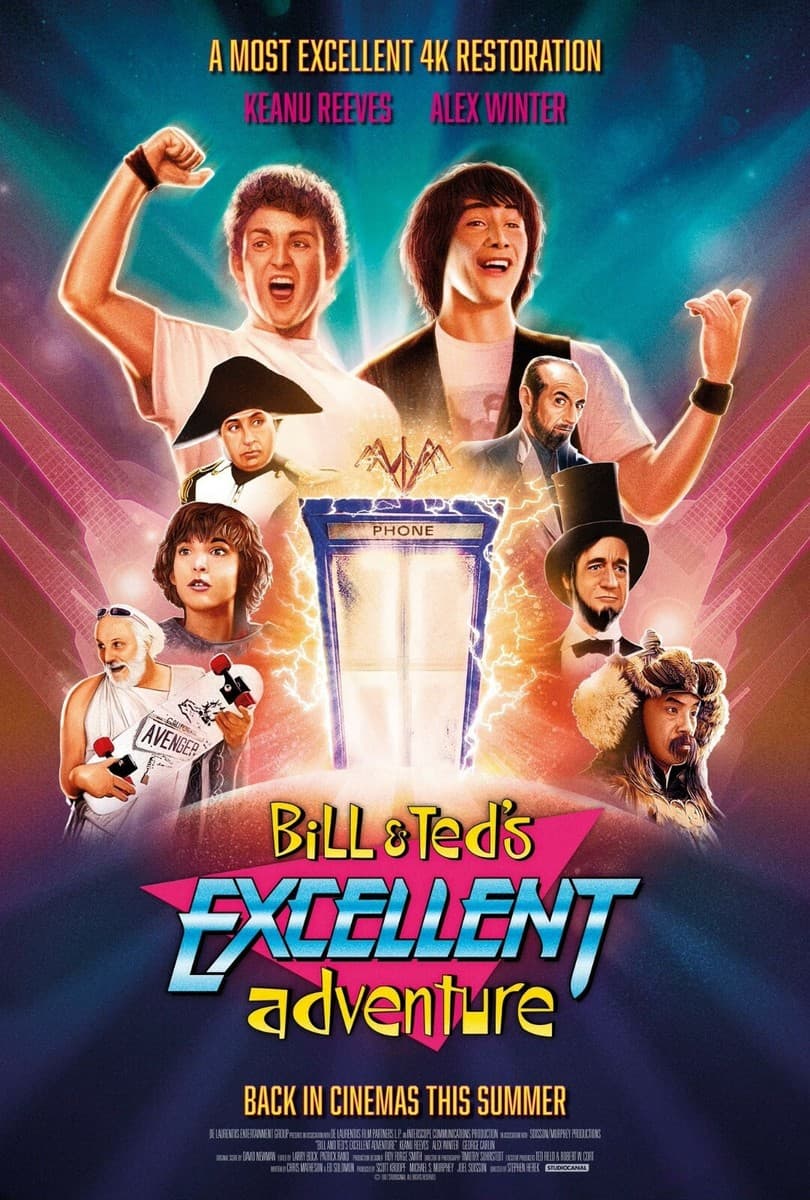
Bill & Ted's Excellent Adventure
A daft time‑travel comedy where being mates saves the world — and yes, Ted matters more than you remember.
The setup
Bill & Ted's Excellent Adventure is the kind of movie you can describe in a sentence and still not explain why people keep watching it. It's short, silly and joyous in a way that somehow trusts friendship to do the heavy lifting. Revisit it and you'll notice that its heart is less about the gag‑a‑minute anachronisms and more about two hopelessly loyal teenagers trying, against the odds, not to ruin the future.
THE MOVIE
Ted "Theodore" Logan is still the reason this movie works
Say what you like about the telephone booth or the parade of historical oddballs — Bill & Ted's Excellent Adventure really hangs together because of the pair at its centre. The film sets up two California teenagers, Bill S. Preston, Esq. and Ted "Theodore" Logan, who are perfectly well‑meaning but terrible at school; their band ambitions and friendship are what push the plot forward.
Everything that follows — a warning from a future emissary, a time‑travelling phone booth, a mission to assemble famous figures for a school presentation — exists because someone thinks Bill and Ted’s music will somehow change the world. Rufus turns up with the machine to prevent a future where that doesn't happen, and the movie happily lets the high concept exist to highlight the lads rather than bury them beneath effects.
Directed by Stephen Herek and clocking a trim 89 minutes, the film is very much a comedy built on character relationships. Keanu Reeves plays Ted "Theodore" Logan — and while the movie sprinkles history with absurdity, it never forgets that its engine is two teenagers who refuse to let each other down.
THE SETUP
The idea that sets Bill & Ted's Excellent Adventure in motion
The film's premise is almost deliciously simple: two teenagers must pass a history oral report or their band — and, according to a future visitor, the future itself — is toast. That threat is immediate and specific: Ted faces the prospect of being shipped off to military school if they fail, which gives the comedy a surprisingly sharp personal stake amid the silliness.
Rufus provides the mechanism and the deadline. He brings a phone‑booth time machine and sends Bill and Ted hopping through eras to nick historical figures for the presentation. The movie deliberately leans into that gag‑friendly mechanic — repeated short abductions, mistaken identities and quick exits — so the complications feel like part of the joke rather than a plot about paradoxes.
So the central conflicts are simple and paired: assemble the famous faces and give a convincing report in the present, while also keeping the time machine working long enough to get everyone home. That simplicity lets the film prioritise character moments and cheeky set pieces over explanation.
On a production note, the film even built a futuristic dome at Carefree Studios and used a crane system to move the physical telephone booth during shooting — practical choices that underline how the set pieces were meant to have a tactile presence on screen.
THE CHARACTER
Why Ted "Theodore" Logan matters
Ted is shorthand for the movie’s central refusal to moralise. He and Bill are good‑natured, academically hopeless teenagers — a pair who rarely look further than the next chord progression and yet carry the plot like accidental heroes. That mix of likeability and cluelessness is what makes Ted feel essential rather than incidental.
There’s also a clear emotional pressure on him. Ted’s father, Captain Logan, is ready to ship him off to military school if he flunks, which gives the broad comedy a very human lever: it’s not just about saving a band, it’s about saving a kid from being taken away from his friends and life. That threat lends a few scenes real, if compact, emotional weight.
All of which matters because the film asks us to root for a friendship. Ted’s choices — and Bill’s loyalty in return — are repeatedly what the story depends on. Take that away and the time‑travelling gags lose their hinge.
UNDER THE SURFACE
Bill & Ted's Excellent Adventure has more on its mind than the plot suggests
On the surface it’s a string of comic anachronisms — history figures dragged into the present for laughs. Underneath, the movie is remarkably consistent about a few earnest ideas. Chief among them is friendship and loyalty; the duo’s relationship is the emotional spine that keeps the capers from feeling hollow.
Then there’s music. The film doesn’t treat Wyld Stallyns as mere teen noise; the plot literally posits their future music as the seed of a better society. It’s a goofy notion, yes, but one that gives the film an oddly utopian optimism: art as a social force powerful enough that a future envoy will meddle to protect it.
There’s also the slacker angle. Bill and Ted are not heroic by design — they’re accidental heroes. That slacker identity is central to the humour and to the film’s charm: ordinary, likeable kids stumbling into outsized responsibility.
Finally, the time‑travel mechanics are not used for moral puzzles but for comic anachronism. The film delights in historical figures out of context; it doesn’t ask you to unpack paradoxes, it asks you to enjoy the collision.
PRACTICAL EFFECTS
The effects work that gives Bill & Ted's Excellent Adventure its physical personality
This is a film that relied on tangible props and sets to sell its jokes. The most obvious example is the telephone booth: a constructed, physical time machine that the production crew moved with a large crane and pulley system. That choice keeps the device feeling like part of the world rather than an invisible plot convenience.
Production also built a futuristic dome at Carefree Studios and used constructed locations — a western town, for instance — rather than depending entirely on optical trickery. Those practical set pieces make the film’s anachronistic moments feel immediate; the humour lands because the historical arrivals are interacting with real, touchable environments.
In short: the movie’s personality is partly tactile. When a character stumbles out of the booth, you can see the set and the effort behind it, which helps sell both the comedy and the oddball earnestness.
PURE 80S
Bill & Ted's Excellent Adventure could not belong to any other decade
Premiering in February 1989, the film sits at a late‑80s sweet spot where high‑concept science fiction could be paired with teen slacker comedy without any irony police showing up. It’s exactly the sort of hybrid that felt right then: a breezy teen movie that was happy to hitch itself to a silly sci‑fi idea and see what happened.
That period feel also explains how the film spared time for pure, goofy optimism — the idea that two kids in a garage band might change the future. It’s an earnestness that feels of its moment: unbothered by grimness and ready to believe in improbable futures.
The fact that the characters were revisited decades later shows the story’s roots in that era. The movie is of the eighties in the way it trusts a simple premise and doesn’t overcomplicate it.
WATCHING IT NOW
What has aged — and what hasn't
The thing that ages best is what the film always relied on: friendship. The central relationship between Bill and Ted remains easy to watch because the stakes are clear and small in human terms — pass the class, keep your pal from being taken away — and the film never undercuts that simplicity.
The plot’s central contrivance — teenagers ferrying famous figures into the present for a school presentation because a future emissary claims their band will found a utopia — still reads as charmingly bonkers. It’s a premise that doesn’t ask for much from the viewer beyond a willingness to be amused.
Contextually, the movie’s initial critical reception was cool, but it picked up an audience quickly and became a sleeper success; that history explains why it’s easier to spot affection for the film today than scorn. For contemporary viewers who like quick, character‑led comedies, it still offers a rewarding ninety minutes.
Finally, the fact the characters returned in sequels and later revisitations suggests that what the film got right — its optimism and the bond between the leads — has had staying power.
THE LEGACY
Why Bill & Ted's Excellent Adventure still matters
The film matters because it started something. It launched a multi‑entry franchise — a direct sequel in 1991, an animated series within a year, and a much later sequel in 2020 — which indicates the characters had life beyond a one‑off joke.
It’s also remembered as a sleeper commercial success that established a set of recurring catchphrases and a comic tone the franchise returned to repeatedly. Those elements helped the film travel into television and further features rather than being a forgotten curiosity.
Ultimately its legacy is modest and straightforward: a small, affectionate comedy that proved popular enough to become a continuing property, carrying its central ideas — the lads, the band, the cheerful optimism — forward for decades.
THE VERDICT
Does Bill & Ted's Excellent Adventure still hold up?
Yes — but with a caveat. If you seek a tidy, clever time‑travel puzzle, this isn’t it. The film’s pleasures are social and silly: two good‑natured, academically inept teenagers whose friendship and band ambitions drive a plot where a future emissary intervenes because the lads’ music will, improbably, help build a peaceful world.
That setup gives the movie a lovely, daft confidence. The stakes are small and human — Ted’s threatened exile to military school, the need to pull off a history presentation — and the film keeps its tone light and propulsive. The phone‑booth mechanic, the doppelganger gags and the parade of famous faces all exist to put the friendship to the test and then celebrate it.
Practically, it’s compact — under ninety minutes — and it doesn’t overstay its welcome. The production choices (a constructed booth, physical sets) keep the nonsense tactile, which helps the humour land. And the film’s ability to spin a sleeper success into sequels and TV shows suggests it did something audiences liked.
So should you watch it today? If you want a short, affectionate comedy that prefers mateship and goofy optimism to cynical wit, yes. It’s still excellent enough — chiefly because the lads refuse to let each other down.
Share this movie
Keep watching
More movies from the 80s
1986
Jumpin' Jack Flash
Jumpin' Jack Flash: our relationship with technology and freedom, and why this 1986 movie still matters.
Read our take →
1987
RoboCop
A murdered cop rebuilt as a product — RoboCop still asks who gets to sell justice.
Read our take →
1983
Christine
Obsession, adolescence and a car that won't let go.
Read our take →