The setup
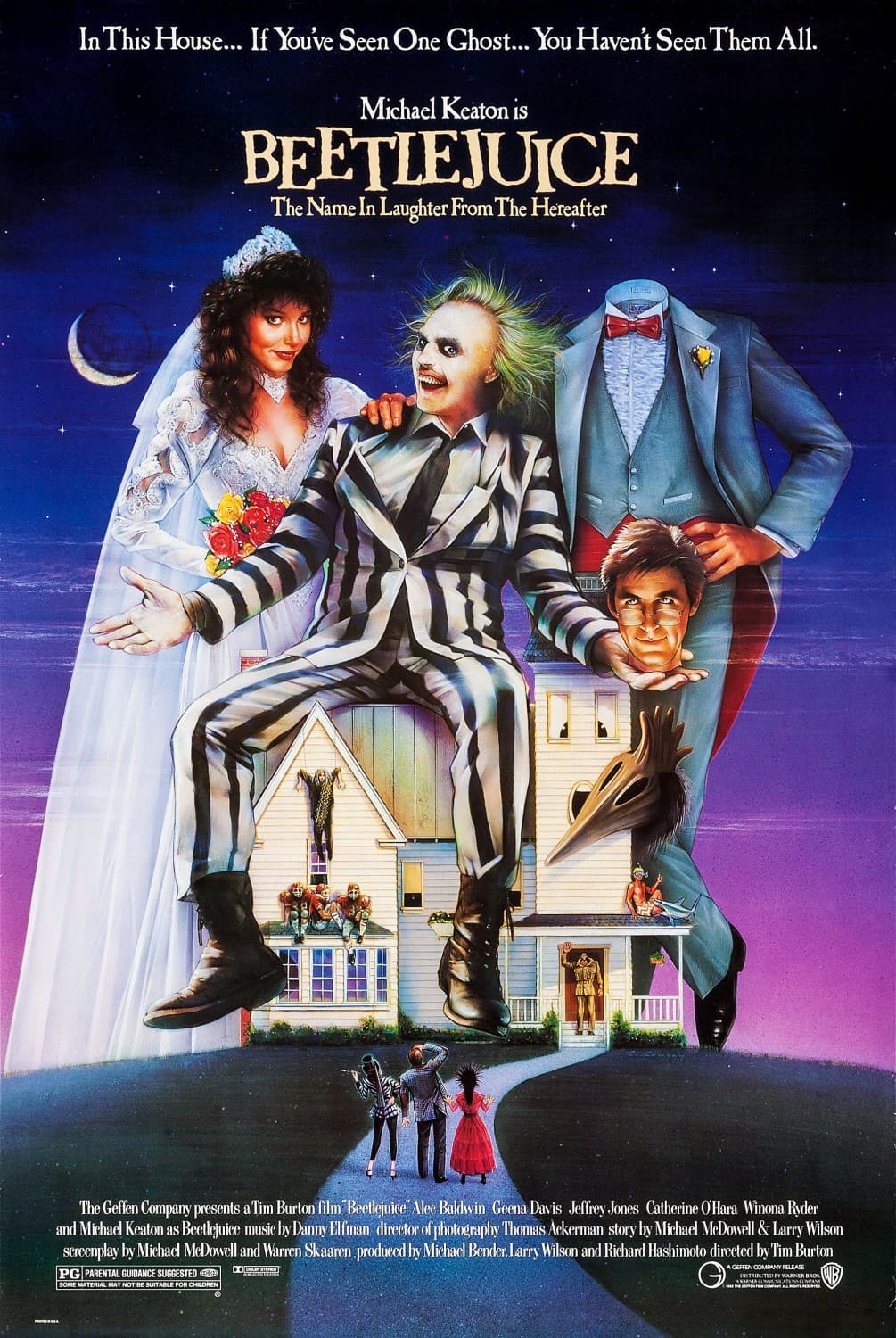
Beetlejuice still lives in the popular imagination because of its riotous centre — the creature called Betelgeuse — and the way Tim Burton dresses a family squabble in funeral finery. It’s a comedy about death that treats the afterlife like an office full of forms, and it gets properly odd when the living and the dead start arguing over who gets to keep a suburban house.
THE MOVIE
Betelgeuse (Beetlejuice) is still the reason this movie works
You can describe Beetlejuice as a comedy-horror with gothic trimmings, but that would miss why people keep coming back to it: the whole thing pivots on one character who refuses to be polite. The Maitlands — a practical, homespun couple attached to their house — die in a traffic accident and find their tidy domestic life interrupted by a new family who move in and redecorate without asking.
Being dead in this film isn’t dramatic or mystical; it’s bureaucratic. There are rules, forms and a set of comic procedures for haunting and exorcism, and when the Maitlands’ polite attempts to scare the newcomers fail they do what anyone desperate would do — they call in outside help, and that help is Betelgeuse, a self-appointed bio‑exorcist who upends everything.
Tim Burton directs the whole package with a playful theatricality across a brisk 92 minutes, and Michael Keaton’s name is attached to the part that most people remember. That three-way mix — the domestic grievance, the afterlife’s absurd rules and one gloriously anarchic summoned presence — is why Beetlejuice still feels worth talking about.
THE SETUP
The idea that sets Beetlejuice in motion
The film starts from a straightforward, almost domestic idea: a husband and wife who love their home find themselves on the wrong side of a crash and, as ghosts, discover their house is no longer theirs. That simple grievance — a home under new management — gives the comedy its engine.
Lydia Deetz, the household’s goth teenager, is the bridge between worlds: she sees the Maitlands and becomes the person able to talk with them. Her presence makes the ghost-versus-resident rows feel intimate rather than abstract.
Burton and his team represent the supernatural with hands-on tricks. The movie relies on miniatures, prosthetics, puppetry and optical composites to make the afterlife feel uncluttered and tactile rather than merely digital or distant.
And underpinning those choices is the film’s consistent interest in death and afterlife — not as spiritual wallpaper, but as a set of procedures and absurdities that the characters must navigate.
THE CHARACTER
Why Betelgeuse (Beetlejuice) matters
Betelgeuse isn’t a ghost of polite sorrow. He’s presented as a brash, anarchic bio‑exorcist — the sort of arrival that turns a domestic squabble into chaos. When he turns up, the stakes change from ‘can we keep our home?’ to ‘how do we survive the person who’s supposed to help?’
That escalation is crucial. The Maitlands’ problem is small and familiar: their house has been taken. Betelgeuse turns it into a theatrical, destructive force that refuses to respect boundaries or taste, and the movie leans into that clash between ordinary domesticity and a genuinely disruptive presence.
And because Michael Keaton plays him, the character sits at the film’s centre: Burton’s design work and the production’s overall look are often mentioned in circulation, but it’s Betelgeuse who makes the story combustible.
THE PERFORMANCE
Why Michael Keaton's performance matters
Contemporary critics singled out Michael Keaton for attention — his work on Beetlejuice (and Clean and Sober) earned him recognition from organisations such as the National Society of Film Critics. That’s not a detail to drop into a puff piece; it explains why his presence shaped reception from the start.
The coverage around the film repeatedly ties Keaton’s central turn to its identity: his take on Betelgeuse is frequently named as a key ingredient in how the movie reads and is remembered.
Put simply, the performance arrived as part of the whole recipe. It’s one of the things reviews and later discussions kept returning to when they described the film’s energy and tone.
UNDER THE SURFACE
Beetlejuice has more on its mind than the plot suggests
On the surface it’s a ghost story with a lot of jokes. Underneath, it’s curious about what happens when people lose a home and something else moves in. That theme of domestic displacement — ordinary people shoved out by new tastes and new management — gives the film unexpected bite.
Burton also stages a small satire of art‑world taste and gentrification. The Deetzes’ aesthetic remodelling of the Maitland house produces comic friction: their idea of improvement reads like a takeover, and the film makes room to laugh at that collision.
There’s a related interest in outsiders and the social order. Lydia, the goth teenager who can see the dead, the Maitlands as displaced homeowners and Betelgeuse as a disorderly intruder — the story keeps returning to people who sit outside whatever the local rules happen to be.
And through all this runs the film’s idea of death: not as mystery but as a system. The afterlife in Beetlejuice has its own processes and officialdom, which the comedy exploits to make the living-versus-dead rows feel both absurd and oddly bureaucratic.
THE FILMMAKING
How Beetlejuice was put together
Tim Burton directs with a kind of theatrical bravado: the film foregrounds gothic production design, staged set pieces and deliberately exaggerated setups that keep the tone lively rather than grim.
Production designer Bo Welch and his art department went for sets that feel deliberately cartoonish, from the Maitlands’ house interiors to the sandworm sequence; those choices push the film away from realism and toward a heightened, fantastical world.
The crew credits hint at the technical team behind that look: Thomas E. Ackerman served as director of photography, Bo Welch handled production design and Jane Kurson edited the film — names that, together, shaped how Burton’s vision landed on screen.
Creature and makeup work was planned carefully: Robert Short supervised creature design and reported months of pre‑production to design and build the necessary practical pieces that would be filmed on set.
PRACTICAL EFFECTS
The effects work that gives Beetlejuice its physical personality
Beetlejuice looks and feels handmade. The production favoured a low‑ to mid‑budget practical approach that mixed prosthetic makeup, puppetry, miniatures and replacement‑animation or stop‑motion elements with optical composites.
Robert Short led the creature and makeup work and spent months in pre‑production building models and effects that could be filmed live on set, which helped the film maintain a physical presence rather than relying purely on post‑production tricks.
A small, cost‑conscious visual‑effects team used on‑set mechanical rigs, miniatures and animated replacement components for key supernatural shots — an economical but tactile toolkit that gives the movie its physical personality.
PURE 80S
Beetlejuice could not belong to any other decade
Beetlejuice lands where Tim Burton’s earlier offbeat sensibilities met a bigger studio canvas: it arrived after his work on Pee‑wee’s Big Adventure and helped raise his mainstream profile by slotting those oddball instincts into a commercial frame.
Its willingness to blend horror tropes with broad, offbeat comedy and a high‑concept production design feels very much of the late 1980s, a moment when genre experiments that mixed commercial comedy with gothic or fantastical elements were finding space in the mainstream.
The production itself straddled location and studio work — principal photography began in March 1987 with location shooting in East Corinth, Vermont supplemented by additional production at Culver Studios — which helped the film feel both grounded and staged.
THE LEGACY
Why Beetlejuice still matters
Part of Beetlejuice’s afterlife is practical: it won the Academy Award for Best Makeup, a recognition that points to the care taken in the film’s creature and prosthetic work.
The film also reached beyond the cinema screen — an animated television series followed in 1989, and the property later found life on stage and in long‑discussed sequel projects; the story didn’t simply vanish after its theatrical run.
Crucially, Beetlejuice helped lift Tim Burton’s commercial visibility. It’s frequently brought up in retrospectives as a landmark of his early feature work, in part because it showed how his offbeat sensibility could sit inside a mainstream comedy‑horror.
THE VERDICT
Does Beetlejuice still hold up?
Yes — and not just because of nostalgia. The film’s compact premise (a couple who become ghosts trying to reclaim their home, then summoning a bio‑exorcist when polite haunting fails) gives it a clear, comic spine that the rest of the movie dresses up with invention.
It’s also a movie about odd systems: the afterlife here behaves like an officious bureaucracy, which keeps the jokes specific and repeatable rather than vague. That specificity, plus the tactile practical‑effects work, keeps the film lively even when the gags are broad.
Michael Keaton’s turn as Betelgeuse is central to whether the film works for you. Contemporary coverage singled out his performance — critics recognised his energy, sometimes praising it and sometimes calling aspects overplayed — and that argument is baked into the film’s rhythm: the piece wants someone to unsettle the domestic scene, and Keaton provides that force.
If you like a movie that pairs a clear, slightly domestic grievance with theatrical oddness and a cast of colourful characters, Beetlejuice still delivers. It’s rowdy, it’s mischievous, and it remembers that death can be as absurd as life.
Share this movie
Keep watching
More movies from the 80s
1986
Jumpin' Jack Flash
Jumpin' Jack Flash: our relationship with technology and freedom, and why this 1986 movie still matters.
Read our take →
1987
RoboCop
A murdered cop rebuilt as a product — RoboCop still asks who gets to sell justice.
Read our take →
1983
Christine
Obsession, adolescence and a car that won't let go.
Read our take →