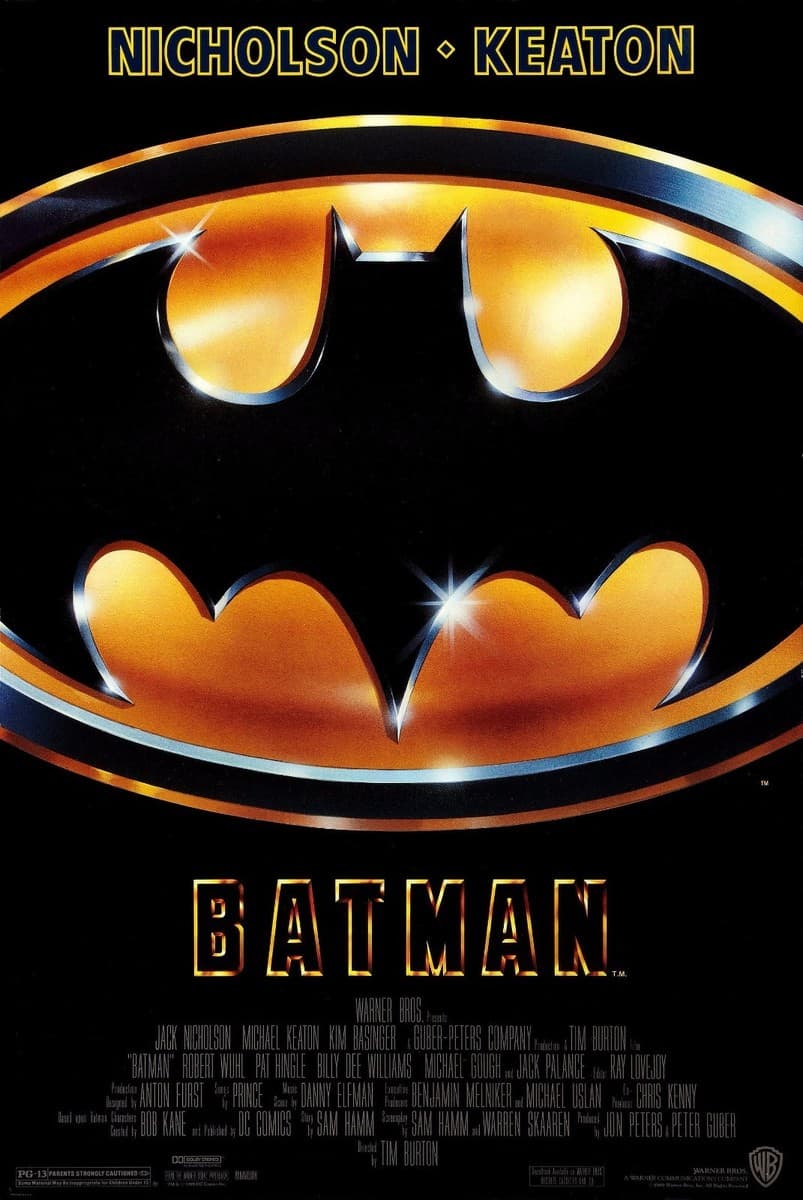
Batman
A stylish, strange take on Gotham where the man behind the cowl keeps the picture grounded.
The setup
Tim Burton's Batman isn't just a superhero movie dressed in black; it's a clash between two showmen — one who hides in the shadows and one who performs chaos on live television. Revisit it for the duel between Bruce Wayne's private rules and the Joker's appetite for spectacle, and for the way a very particular visual and commercial ambition made Gotham feel like a place you could both fear and admire.
THE MOVIE
Bruce Wayne / Batman is still the reason this movie works
People still talk about Batman because, at its centre, it has a very simple engine: Bruce Wayne who chooses to be Batman. That choice — a private code that places one man outside the law to stop a wave of murders and organised crime — gives the whole film its moral thrum and its theatrical stakes.
Tim Burton frames that moral thrum against a showman of chaos. Jack Napier’s transformation into the Joker (the chemical-plant origin is set out on-screen) turns a gangster into a performer who weaponises spectacle and public terror. The film becomes less about detective work and more about how two very different kinds of performance reshape Gotham.
Around those performances are unmistakable, unmistakeable production choices: Michael Keaton as the man in the cowl, Jack Nicholson as the man with the grin, Kim Basinger as the civilian touchstone Vicki Vale, Danny Elfman’s score and a production design that intentionally makes the city feel staged. Burton’s 1989 Batman runs for two hours and six minutes, and it wears that running time like a carefully constructed costume.
THE CHARACTER
Why Bruce Wayne / Batman matters
Bruce Wayne matters because he is the fulcrum the movie turns on. Michael Keaton plays him, and the film keeps returning to the idea of a man who deliberately splits his life into a public face and a hidden, uncompromising practice.
That split — Wayne the social fixture, Batman the shadowed enforcer — makes the film watchable in moments that could otherwise have been pure spectacle. The audience needs someone to care about the city in private if the Joker is going to make the city public theatre.
Vicki Vale functions as the civilian touchstone: her work as an investigative photographer and journalist gives Bruce a reason to be seen without the cowl, and her encounters with the Joker make the stakes personal rather than abstract.
So the film’s emotional architecture is simple and effective: a divided protagonist who anchors a story about performance, publicity and the cost of policing from outside the system.
UNDER THE SURFACE
Batman has more on its mind than the plot suggests
At one level Batman is a neo-noir action picture; at another it’s a film about masks. The dual identity of Bruce Wayne versus Batman isn’t just a costume trick — it’s the organising idea. The film keeps asking what a person gives up when they split themselves for a cause.
That split meets its opposite in the Joker, who weaponises chaos and spectacle. He stages public events that turn the city into a theatre of terror, forcing private grief and civic panic into the light for everyone to watch.
Tim Burton himself framed the movie as a clash between outsiders — a ‘duel of the freaks’ — which is useful shorthand. If Batman is an outsider who answers to a personal code, the Joker is an outsider who answers to applause and anarchy.
Those tensions — private code versus public chaos, outsider versus outsider — make the film more than its set pieces. They turn chase sequences into arguments and broadcasts into confrontations over who gets to define Gotham's public life.
THE FILMMAKING
How Batman was put together
You can tell a lot about a director’s priorities by where they spend their budget and attention. For Burton, the city itself needed to be an argument — imposing, theatrical and deliberately stylised — and Anton Furst’s production design became the movie’s most visible creative statement.
Furst’s approach leans on an Art Deco and expressionist sensibility that makes Gotham feel less like a real place and more like a constructed myth. That stylisation gives the film its ability to oscillate between menace and spectacle without losing coherence.
The production design wasn’t a mere accessory: it was the element the film insisted would define its tone, and it was recognised for that. The movie’s look tells you immediately what kind of Batman this will be — not simply a comic-book trawl but a mood piece with teeth.
Put simply: Burton’s Gotham is a stage, and the production design is the set that lets the actors play large without the city collapsing around them.
PRACTICAL EFFECTS
The effects work that gives Batman its physical personality
Burton’s Gotham was realised with hands-on methods. The production relied on physical models and miniatures — a choice that makes a constructed city feel tactile and deliberately crafted.
Vehicle work was similarly practical. Multiple full-size Batmobile builds were created for on-set sequences, giving the car a physical presence rather than a purely cinematic shorthand.
The Joker’s face was also the product of old-school movie craft. Prosthetic makeup and facial appliances were used to create Nicholson’s appearance; the makeup design required multi-hour application and removal routines.
All of these choices keep the movie rooted in the physical world it construes, which matters when you want spectacle to feel real as well as dramatic.
PURE 80S
Batman could not belong to any other decade
Batman opened in June 1989 at a moment when studios were learning how to turn familiar properties into very big commercial events. The picture was treated as a tentpole — a pre-sold property around which large marketing and merchandising campaigns were built.
That commercial ambition reshaped how the film was presented: the release generated intense publicity and a wave of merchandising that fed into a late-80s studio strategy of turning characters into nationwide phenomena.
So the film’s place in the decade is not just stylistic. It’s industrial: a movie that helped crystallise how blockbusters would be sold, promoted and merchandised as brands rather than single releases.
In other words, Batman is of its time because it was made by and for an industry that now thought in franchises and saturated campaigns — and the movie wears that thinking on its sleeve.
THE LEGACY
Why Batman still matters
Part of why this Batman keeps cropping up in conversations is the way certain production choices were rewarded and remembered. The film’s art direction received top industry recognition, which keeps Anton Furst’s vision part of the movie’s afterlife.
It also spawned direct continuations on screen and in animation; the film led to Burton’s sequel and helped open a path to expanded media, including Batman: The Animated Series a few years later.
Industry histories return to the movie when discussing the modern blockbuster model: it’s often cited as an example of how darker tones and broad marketing could be married to reach mass audiences.
Put plainly: the film matters because its visual ambitions were celebrated, because it continued into a franchise, and because it’s part of how studios learned to sell spectacle as spectacle.
THE VERDICT
Does Batman still hold up?
Yes — but with a caveat. If you come for a story about a man who turns private grief into public duty and for the theatre of a villain who stages chaos as a broadcast, this Batman still delivers. The picture sets out a clear premise: Bruce Wayne/Batman defends Gotham against a crime wave catalysed by the Joker’s emergence, and much of the film’s momentum comes from that personal rivalry.
The movie stages its confrontation as a series of escalating exhibitions — investigative set pieces involving characters like Alexander Knox and Vicki Vale alternate with the Joker’s public taunts and spectacles — and that structure still holds up as a way to build stakes. It’s a showdown that reads as a thematic duel: two outsiders pushing opposite solutions onto a city.
Casting was part of the conversation then and remains part of the picture now. Michael Keaton plays Bruce Wayne/Batman and Jack Nicholson plays Jack Napier/The Joker; contemporary responses singled out the casting decisions as controversial and much-discussed. That discussion is itself useful: the movie invited risk, and the risks are visible on-screen.
So should you watch it today? If you want a superhero picture shaped around personality, theatrical opposition, striking production design and a publicity-minded studio ambition, this Batman is worth revisiting. It’s less a faithful comic-book replica and more a peculiar, stylised duel between a man who polices from the roof and a man who polices the airwaves — and that oddness is the point.
Share this movie
Keep watching
More movies from the 80s
1986
Jumpin' Jack Flash
Jumpin' Jack Flash: our relationship with technology and freedom, and why this 1986 movie still matters.
Read our take →
1987
RoboCop
A murdered cop rebuilt as a product — RoboCop still asks who gets to sell justice.
Read our take →
1983
Christine
Obsession, adolescence and a car that won't let go.
Read our take →