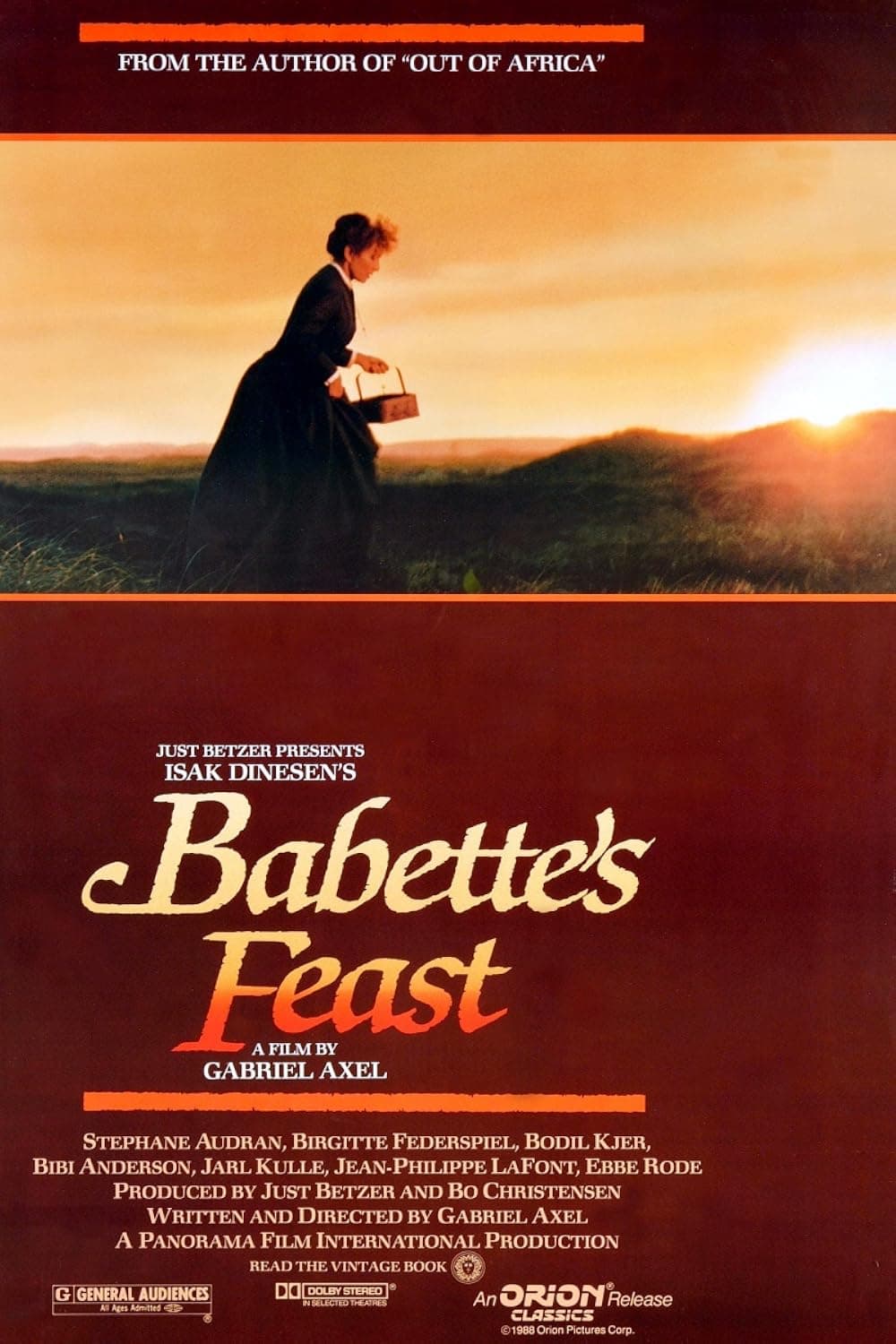
Babette's Feast
A refugee, a single extravagant dinner and the curious way generosity becomes a kind of worship.
The setup
Babette's Feast is the sort of film that arrives like a present: modest on the outside, then quietly astonishing once you open it. Gabriel Axel's 1987 adaptation of a Karen Blixen tale keeps its eye on one woman — Babette Hersant — and discovers how one act of artistic generosity can loosen old griefs and tighten a community's bonds.
THE MOVIE
Babette Hersant is still the reason this movie works
If you can picture the moment when a room falls properly silent because everyone is tasting something they didn't know they needed, you've already felt the heart of Babette's Feast. The film's engine is simple: a French refugee, taken in by two pious sisters, quietly carries a professional past and chooses to spend a sudden windfall on one costly, lavish dinner.
Gabriel Axel built the picture around that single gamble. It's a deliberately small story — set in a windswept Jutland hamlet, clocking in at just over an hour and a half — but it keeps widening until the private histories of the villagers and Babette's own exile lock together.
Stéphane Audran plays the title role, and it's Babette's decision — to let her art speak where words won't — that gives the film its moral and dramatic curiosity. That contrast between artistic pleasure and ascetic restraint is what makes the movie worth revisiting.
THE SETUP
The idea that sets Babette's Feast in motion
At its centre Babette's Feast is built on a tidy but rich premise: two elderly, devout sisters who run a small pietistic congregation take in a French refugee, and years later she announces she wishes to prepare an elaborate dinner because of a sudden windfall. The narrative keeps things contained around that single gesture.
The film relocates Blixen's tale to a western Jutland village, and that geography matters because the community's restraint — a kind of moral economy of thrift, memory and duty — is constantly measured against what Babette brings to the table.
The central conflict is economical and spiritual rather than melodramatic: the villagers' ascetic, religious restraint versus the sensory, artistic pleasures embodied in Babette's cuisine. The dinner isn't just food on plates; it's a test of what a community can receive.
Crucially, the feast functions as the catalyst. It doesn't perform miraculous conversions so much as unlock buried recollections, reconciliations and second chances among the guests while the film keeps its quieter moral tone intact.
THE CHARACTER
Why Babette Hersant matters
Babette is the rare cinematic outsider who quiets a room by what she gives rather than what she demands. The fact that she is a displaced French cook with a hidden professional past means every modest action carries a double weight: practical service and an unspoken artistic biography.
That hidden life is important because it reframes the banquet as an aesthetic statement. Babette doesn't merely cook; she stages a single, costly work of culinary art, and that choice makes her an agent of change without rewriting the villagers into caricatures.
Her role matters because she forces the community to reckon with pleasure as a language. In a place governed by restraint, Babette's offering becomes the only way some characters can encounter grace, memory and the possibility of repair.
THE PERFORMANCE
Why Stéphane Audran's performance matters
Stéphane Audran is credited as the actress playing Babette, and that casting decision is the practical centre of the film: the story requires a performer who can be both discreet and quietly authoritative.
Because the film places Babette at its emotional fulcrum, the casting functions like a piece of stagecraft — the right presence allows the quiet stakes of a dinner to feel like a minor sacrament to a small congregation.
Beyond the screen credit, the movie is structured so that the viewer discovers Babette in the same gradual way the villagers do: through service, gesture and a single uncompromising meal.
UNDER THE SURFACE
Babette's Feast has more on its mind than the plot suggests
On the surface it's a story about a dinner. Underneath it, the film is quietly interested in art versus asceticism: how an act of creation — here, culinary — stands up against a community built on restraint.
Exile and belonging are woven through Babette's backstory; she is a refugee and former Parisian cook, so questions of identity, gratitude and cultural exchange are never far from the foreground. The banquet becomes a site where these tensions are negotiated.
Memory and second chances pulse through the guests' reactions. The feast reactivates old romances and regrets, giving characters the opportunity to remember otherwise sealed parts of their lives.
Finally, the movie treats sensory pleasure as morally legible. It's not hedonism for its own sake: generosity is presented almost sacramentally, a deliberate offering that opens people rather than simply feeding them.
THE FILMMAKING
How Babette's Feast was put together
Gabriel Axel made clear production choices that keep the story intimate. The camerawork and the editing — credited to Henning Kristiansen and Finn Henriksen respectively — favour patience over flourish, which lets the meal and the reactions breathe.
Sven Wichmann's production design supported that restraint by creating a believable village world. The production deliberately shifted the original story's Norwegian setting to western Jutland and mixed real locations, such as Mårup Church, with constructed village sets.
Those choices matter because the film is always balancing the ordinary against the ceremonial. The designs and the film's assembled rhythm ensure the banquet feels both domestic and extraordinary.
PURE 80S
Babette's Feast could not belong to any other decade
Produced and released in 1987, Babette's Feast sits comfortably in the late-80s European arthouse moment: films that preferred small, carefully told stories with international ambitions rather than Hollywood scale.
Its premiere in Un Certain Regard at Cannes the same year signalled that it was part of a festival circuit searching for refined, literary adaptations rather than blockbusters.
That timing helped the film travel beyond Denmark; the late 1980s were a moment when modest, well-crafted foreign-language films could find international audiences, and Babette's quiet confidence fits that pattern.
WATCHING IT NOW
What has aged — and what hasn't
A lot of the film's contemporary appeal rests on themes that still resonate: exile and belonging remain immediately recognisable experiences, and Babette's status as an outsider who offers something to the community still rings true.
The structure — centring a single significant meal as the narrative hinge — also reads well today. It's a tidy device that lets private memories and reconciliations surface naturally without needing modern pacing tricks.
Because the story leans on small, human gestures rather than spectacle, it avoids feeling artificially dated; the core emotional transactions (gratitude, regret, reunion) are durable.
What may feel less familiar are the film's cultural assumptions about ritual and community. But those moments are part of the point: the film asks whether sensory pleasure can itself be a means to moral and relational restoration.
THE LEGACY
Why Babette's Feast still matters
Babette's Feast earned significant international recognition: it won the Academy Award for Best Foreign Language Film in 1988 and the BAFTA for Best Film Not in the English Language, achievements that brought renewed attention to Danish cinema.
The film's afterlife has continued in a quieter, curatorial way: Criterion issued a restored high-definition release with new interviews and supplementary material, and the movie frequently appears in programming and academic discussions about food and religion on screen.
There have also been persistent attempts to reimagine the story for other audiences, reflecting how its central conceit — one transformative meal — keeps inviting retelling rather than mere imitation.
Put simply, the film endures because its concerns — generosity, exile, art's capacity to heal — are both personally moving and easy to carry into new contexts.
THE VERDICT
Does Babette's Feast still hold up?
Yes — but on its own modest terms. Babette's Feast is built around a single decision: Babette wins a lottery and chooses to spend her winnings on an extravagant banquet for the sisters and their congregation. That choice is the movie's moral and narrative spine.
If you're looking for big plot turns or moral melodrama, this isn't the film for you. Instead it asks you to notice how a carefully made meal can expose old regrets, reopen romances and quietly nudge people toward reconciliation without changing the community's essential character.
Stéphane Audran's role as Babette anchors the whole affair: the casting places her at the film's centre so the banquet can function as both practical generosity and a near-sacramental event.
So watch it if you like small, well-made dramas that treat sensual pleasure as a serious language for human repair. Babette's Feast still feels like an invitation — not to spectacle, but to sit down and be given something.
Share this movie
Keep watching
More movies from the 80s

1986
Jumpin' Jack Flash
Jumpin' Jack Flash: our relationship with technology and freedom, and why this 1986 movie still matters.
Read our take →

1987
RoboCop
A murdered cop rebuilt as a product — RoboCop still asks who gets to sell justice.
Read our take →

1983
Christine
Obsession, adolescence and a car that won't let go.
Read our take →