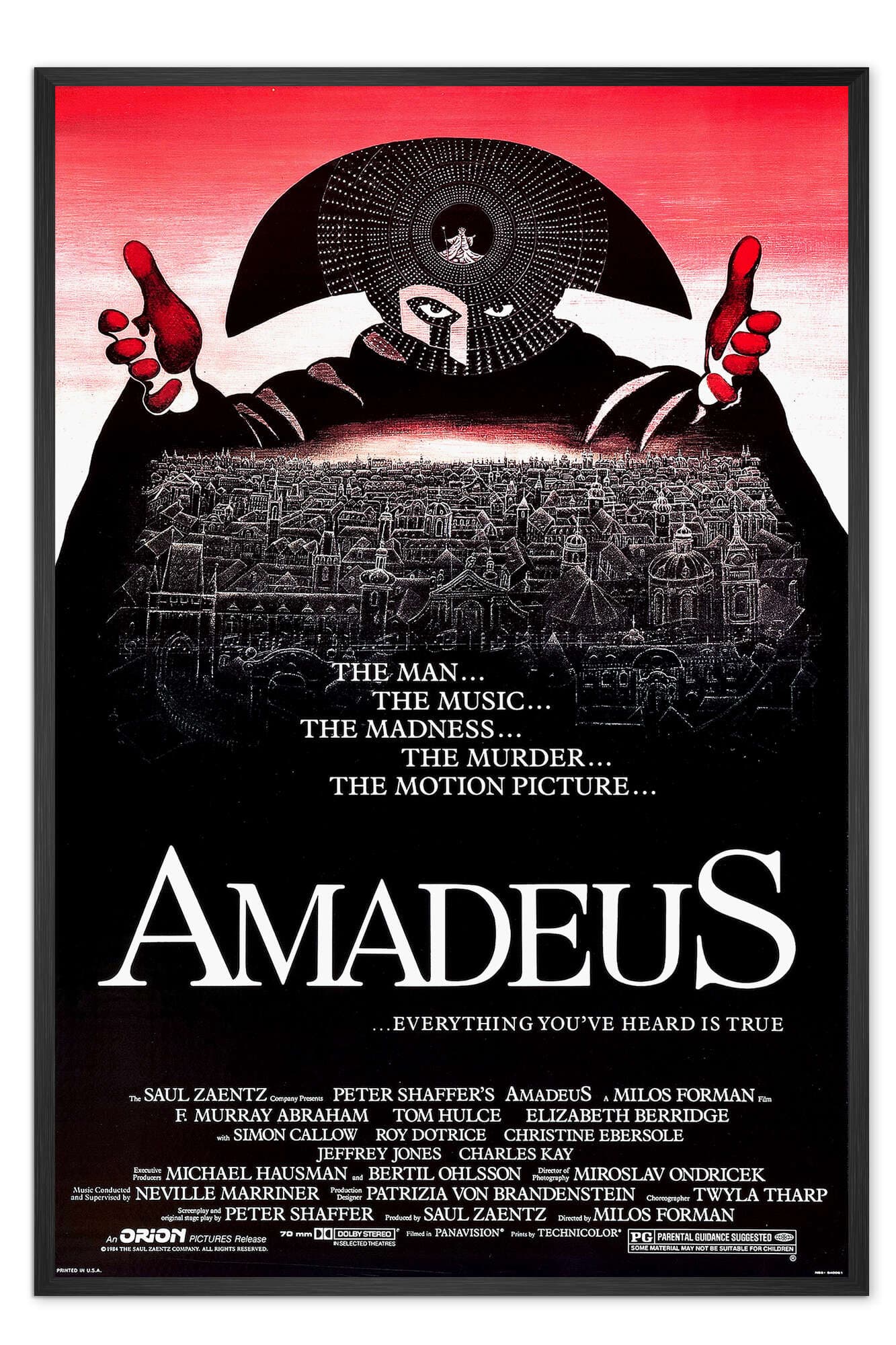
Amadeus
A tale of genius through the jealous eyes of a faithful man — and a confession that never lets you look away.
The setup
Amadeus keeps turning up in conversations because it gives us a deliciously human place to stand while great music happens: right beside a man who cannot forgive someone else for being born brilliant. Miloš Forman staged that collision between talent and resentment as a theatrical, often savage courtroom of memory, and the film still asks the same question: what do you do when God appears to play favourites?
THE MOVIE
Antonio Salieri is still the reason this movie works
People still talk about Amadeus because it gives us a narrator who is both pitiable and dangerous: an elderly Antonio Salieri, holed up in an asylum, confessing the story of his rivalry with Mozart. That framing — a lifetime told to a priest as a kind of atonement and accusation — is the film’s slyest move. It makes every memory suspect and every motive theatrical.
The engine that follows is simple and bitter: Salieri, a devout, hardworking court composer, recognizes Mozart’s extraordinary gifts and transforms admiration into obsession. He resolves not merely to compete but to undermine a talent that, to him, smells of divine injustice.
Directed by Miloš Forman and running just under three hours, Amadeus stages that private war with grandeur — palace rooms, operatic productions, and a score recorded beforehand so the music could breathe on set. And because the picture insists we live inside Salieri’s grievance, the film never quite lets Mozart be only Mozart; instead we see him refracted through another man’s envy.
THE SETUP
The idea that sets Amadeus in motion
At its centre Amadeus is a story told after the fact: Salieri, looking back, lays out how one encounter with Mozart’s music and personality set him on a ruinous path. The film’s opening confession frames everything that follows as memory — and memory, of course, is prone to invention.
That first musical collision is the inciting spark: Salieri’s discovery of Mozart’s gifts does not inspire humility so much as righteous fury. A man who has lived by duty and God suddenly feels cheated by talent that seems to require no work.
From that point the film tracks a moral and spiritual crisis. Salieri is a pious, disciplined court composer whose sense of fairness and divine order collapses as he confronts someone utterly at odds with those values.
Formally the film leans on flashback. Scenes arrive as retellings, which means the audience’s access to motive and fact is always filtered through Salieri’s need to explain — or justify — what he did next.
THE CHARACTER
Why Antonio Salieri matters
Salieri is the film’s magnetic centre because he is where the big ideas get personal. He is not merely jealous in the petty sense; he is a respected court composer whose entire moral account — faith, duty, ambition — is upended when Mozart arrives like a walking provocation.
That tension makes Salieri memorable as a character you can almost understand. He was faithful to system and God, and when the system appears arbitrary his faith becomes a source of rage rather than consolation.
Crucially, Salieri’s jealousy also reframes the rest of the cast. Constanze, for example, isn’t just Mozart’s wife on the margins; she stabilises his domestic life in a way that rubs against Salieri’s own empty devotion and intensifies his resentment.
The film’s dramatized rivalry deliberately mixes fact and invention, so Salieri operates as a dramatic construct — a vehicle for questions about genius, fairness and whether the world rewards its talented or simply tolerates them.
THE PERFORMANCE
Why F. Murray Abraham's performance matters
There’s a practical reason people point to the central turn: F. Murray Abraham’s portrayal of Antonio Salieri was recognised with the Academy Award for Best Actor. That accolade is part of the film’s public story and tells you how the industry received the role.
The Oscar also places the character at the heart of Amadeus’s structure. The movie is, after all, narrated from Salieri’s perspective, and the performance is the vehicle for the confession that shapes the entire film.
Beyond trophies, the production relies on the actor’s ability to carry the film’s moral logic; Salieri must feel compelling enough for us to follow his account, however unreliable it might be.
So whether you approach Amadeus as a period drama or a psychological study, Abraham’s award-winning turn is a clear reason the filmmakers trusted Salieri to steer the story.
UNDER THE SURFACE
Amadeus has more on its mind than the plot suggests
At a glance Amadeus is about rivalry. Underneath, it becomes a study of how envy reshapes a life. Jealousy here is not a momentary failing but a moral engine that convinces Salieri he is owed an explanation from God — and then punishes the universe for withholding it.
The film repeatedly sets genius against mediocrity: Mozart arrives as an almost reckless force of nature while Salieri embodies the slow, respectable competence of institutions. That contrast drives both comedy and cruelty in the picture.
Faith and divine justice run through the story like a nervous current. Salieri’s piety is not a comfort so much as a ledger; when God does not deliver fairness, religious conviction becomes bitterness.
Finally, because the tale is told as a confession, memory and unreliable testimony are always hovering at the edges. We are asked to decide whether we’re watching history or someone rehearsing a grievance that justifies itself in the telling.
THE FILMMAKING
How Amadeus was put together
Forman assembled a film that feels deliberately theatrical without ever becoming small-scale. That comes down in part to production design: the crew used actual Prague palaces furnished with antiques and built a replica of the Volkstheater for the opera sequences.
Shooting in those real locations gives the film a tangible weight; when the camera brings us into a court room or an audience chamber we’re seeing spaces that read as lived-in rather than stagey backdrops.
Because the story spends so much time in performance — the world of opera and public spectacle — having a believable onstage environment matters. The constructed theatre sequences let the filmmakers stage the operatic set-pieces without losing dramatic credibility.
Put simply: the film’s look and scale were achieved by marrying authentic locations with carefully built sets, which made the court and theatre scenes feel like events rather than illustrations.
PRACTICAL EFFECTS
The effects work that gives Amadeus its physical personality
A lot of what sells Amadeus as a period piece is tactile: the production commissioned more than 1,500 period wigs to populate courts and crowds, a detail that builds the film’s crowded, social world.
For interior scenes the team engineered steel and aluminium support grids so they could safely hang extremely heavy candle-lit chandeliers — small practical choices that make palace interiors read as real rather than CGI-era approximations.
The filmmakers also invested in large period sets and real antiques borrowed from Czech palaces, and they constructed a 700‑seat replica of the Volkstheater at Barrandov Studios for onstage action.
These are not flashy effects in the modern sense; they are practical, physical decisions that give the film an authenticity you can feel in every ceremony and performance.
PURE 80S
Amadeus could not belong to any other decade
Amadeus arrived in 1984 at a moment when studios were willing to back stage and literary adaptations as prestige pictures. The film sits neatly in that early‑to‑mid‑80s appetite for serious, theatrical work with big production values.
It was produced by Saul Zaentz’s company and released theatrically by Orion Pictures in the United States in September of 1984, which placed it squarely in the awards season conversation of the time.
Principal photography began in early 1983 and the production shot primarily in Czechoslovakia, using Barrandov Studios for major sets — a logistical scale that matched the industry’s mid-80s willingness to fund ambitious period work.
In short, Amadeus feels like a product of an era when prestige and commerce still negotiated over stage plays and historical material, and the film’s very existence depended on that particular moment of studio confidence.
THE LEGACY
Why Amadeus still matters
There are a few tidy reasons Amadeus keeps turning up in film conversations. First: it was an awards heavyweight, taking home eight Academy Awards including Best Picture, Best Director and Best Actor.
Second: the soundtrack — Mozart’s music recorded under Neville Marriner and performed by the Academy of St Martin in the Fields — crossed over into the popular marketplace in a way most classical recordings rarely do.
Finally, the film has found a place in retrospective discussions and preservation programmes as a major 1980s period picture and a go-to dramatization of composers on screen.
Put together, those facts explain why Amadeus has both an institutional afterlife and an ongoing appeal to viewers who enjoy big, opinionated historical dramas.
THE VERDICT
Does Amadeus still hold up?
Yes. If you want a richly staged, thoughtful picture about envy and the rack of talent versus toil, Amadeus still delivers. The film’s choice to tell everything as Salieri’s confession — a flashback-laced narrative — keeps the moral questions sharp rather than flattening them into a standard biopic.
The premise is brutal and brilliant in its simplicity: a faithful, diligent composer confronts a talent that seems to mock the rules he has lived by, and that tension propels the film. F. Murray Abraham, whose portrayal earned Best Actor recognition, occupies that position as the story’s conscience and grievance.
Forman’s production scale — real palaces, a constructed Volkstheater and a pre-recorded soundtrack so the music could exist on set — gives the film a solidity that supports its dramatic claims. It looks and sounds as if it means every line.
If you’re coming to Amadeus today, watch it as a character study dressed as a period epic: it asks what envy does to a life, and it doesn’t let you pity its protagonist without making you listen to his reasons. That’s why it still matters.
Share this movie
Keep watching
More movies from the 80s
1986
Jumpin' Jack Flash
Jumpin' Jack Flash: our relationship with technology and freedom, and why this 1986 movie still matters.
Read our take →
1987
RoboCop
A murdered cop rebuilt as a product — RoboCop still asks who gets to sell justice.
Read our take →
1983
Christine
Obsession, adolescence and a car that won't let go.
Read our take →