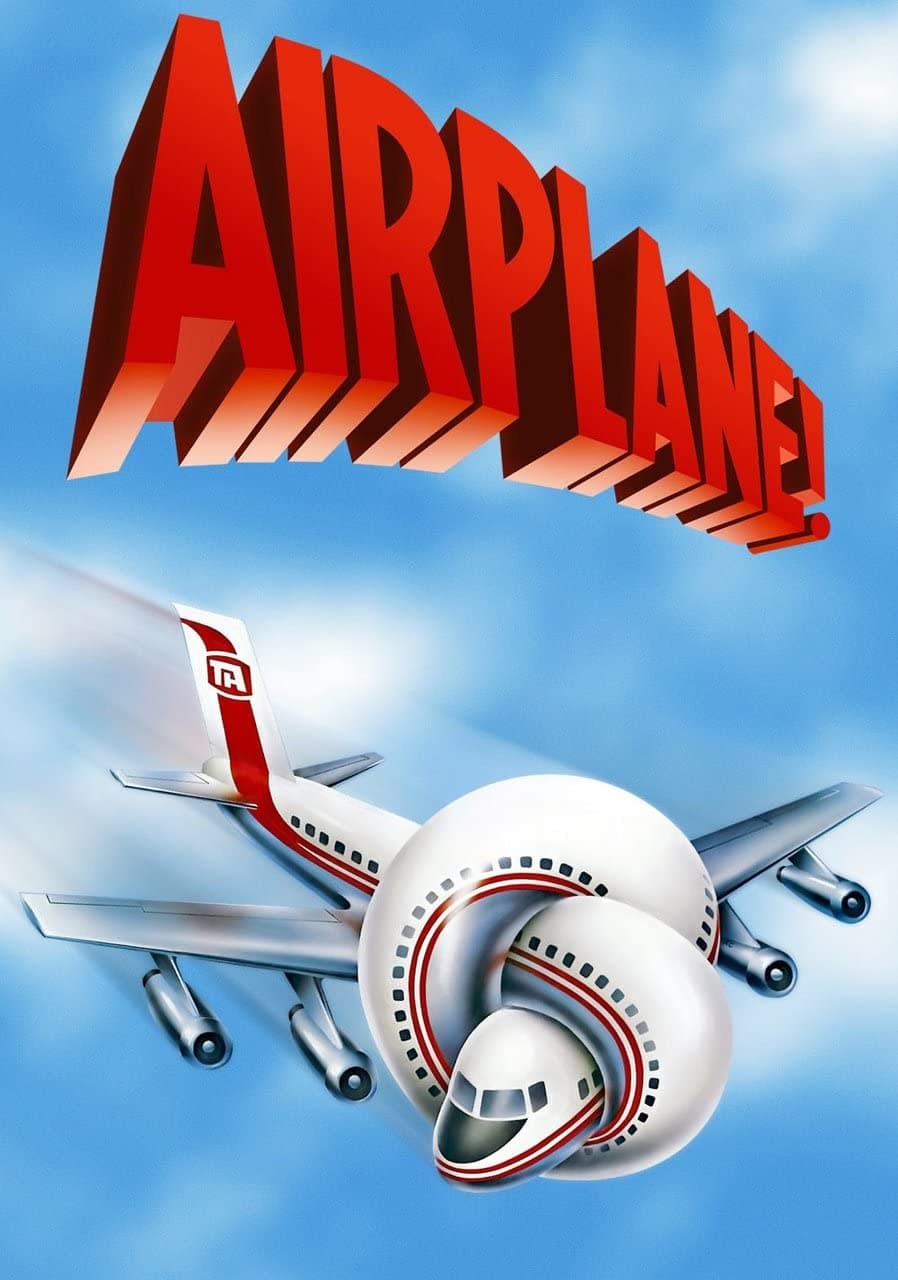
Airplane!
A pilot who can’t fly, a plane full of nonsense — and the odd inflatable hero called Otto.
The setup
Airplane! is the kind of comedy that sneaks up on you: there’s a serious backbone under the silliness and a character who makes the chaos matter. It’s built from an earnest disaster movie, then gleefully pranked by three filmmakers who love sketch comedy. Stick around and you’ll see why Ted Striker keeps the whole thing grounded — even when the jokes don’t.
THE MOVIE
Ted Striker is still the reason this movie works
If you remember one thing about Airplane! it shouldn’t be the gags you can quote back in the pub — it should be why there’s a point to all of them. At the centre is Ted Striker, a former combat pilot who, despite being terrified of flying, has to step up when the impossible happens and the plane needs someone to land it. That emotional through-line gives the film a beat to land on, even as the jokes ricochet off the cabin walls.
What the Zucker brothers and Jim Abrahams did — on their feature debut — was take the sober puzzle of an old disaster picture and treat it like a sketch show. They used the plot skeleton of the 1957 film Zero Hour! and then layered a relentless flood of visual and verbal gags over it. The effect: a movie that feels both meticulously arranged and gleefully anarchic.
You’ll recognise the faces — Robert Hays as Ted Striker and Julie Hagerty as Elaine — and you’ll spot Leslie Nielsen turning up with a perfectly straight line that makes everything around it funnier. But underneath the roster of memorable cameos and recurring bits (yes, even the inflatable autopilot Otto) there’s a real, watchable structure. That’s why people are still talking about Airplane!.
THE SETUP
The idea that sets Airplane! in motion
At face value the plot is uncomplicated: Ted Striker boards a passenger flight to patch things up with his on-off girlfriend Elaine, and then the plane’s crew and many passengers become incapacitated. The simplicity is deliberate — it gives the filmmakers a sturdy framework to work the jokes against without losing the audience in complication.
That framework is not original to Airplane!; the writers borrowed the beats and structure of Zero Hour! and used them as the movie’s spine. The result is a parody that stays loyal to the basic mechanics of the disaster picture even while it lampoons almost every moment of it.
One of the clever things the film does is split attention between the frightened aircraft and the ground controllers guiding the crisis. Characters such as McCroskey and Rex Kramer keep a parallel radio-based action running, which lets the screenplay play with tension and timing while the one-liners and visual gags keep arriving in quick succession.
And because the comedy escalates through running jokes and literal visualisations of wordplay, the story never feels inert — the plot duties are clear (Striker’s inner struggle must resolve if the plane is to be saved), but the film treats that duty as the centrepiece for a barrage of silliness.
THE CHARACTER
Why Ted Striker matters
Ted Striker could easily have been the straight man in a movie designed mainly to show off jokes. Instead, he’s the emotional reason the film keeps you invested. He’s introduced as an ex-military flyer whose wartime memories have left him with a crippling fear of flying — and the plot depends on him finding a way out of that fear.
That setup gives the film stakes beyond the next gag. Ted’s attempt to reconcile with Elaine — the stewardess he’s still involved with on and off — adds a romantic thread that humanises the chaos. It’s not just about whether the plane survives; it’s about whether this person can survive himself.
In short: Ted isn’t merely a vehicle for punchlines. He’s the axis around which the parody turns, the human detail that allows the filmmakers to keep piling on the absurd without it feeling hollow.
UNDER THE SURFACE
Airplane! has more on its mind than the plot suggests
On the face of it Airplane! is a spoof of disaster movies — and that’s true — but it’s also doing quieter things under that riot. The film keeps returning to fear and recovery: Ted’s aerophobia is not a throwaway gag, it’s the engine for the story’s resolution, which gives the jokes something to bounce off.
There’s a deliberate chemistry between deadpan delivery and outright absurdity. The screenplay often asks actors to say utterly ridiculous things with utter seriousness, and that tension between tone and content is where much of the comedy lives. The film refuses to wink at the camera; it treats nonsense as if it were protocol, which forces the audience to choose whether to laugh with it or at it.
Another recurring trick is celebrity cameo inversion. Familiar, often serious faces are used against type, which flips expectations: the presence of those actors becomes a gag in itself and lets the movie poke fun at both the genre it’s copying and the star systems around it.
Put together, these elements mean Airplane! isn’t merely a series of sketches glued to a plot. It’s a sustained joke that knows the rules of the game it’s upsetting, and that discipline is what lets its silliness land.
THE FILMMAKING
How Airplane! was put together
What separates Airplane! from a sketch compilation is how tightly it’s written and directed. Jim Abrahams and the Zucker brothers built the screenplay on the structure of Zero Hour!, then used that sturdy framework to place jokes with surgical timing. The directing and writing credit belongs to the trio — it’s their blueprint from top to bottom.
That approach meant the filmmakers could maintain a steady pace: the plot moves the same way a good sketch show does between beats, and the direction keeps scenes focused so a single gag can hit cleanly before the next one arrives. The result is a short, sharp film that refuses to linger where the joke isn’t working.
You can see why the trio’s sketch background is crucial here — the film thrives on variety and momentum, not on a single sustained set-piece. Treating the movie like an extended comedy sketch gives it the freedom to be both precise and riotous.
All of which underlines that Airplane! is an authored piece: it wears the fingerprints of creators who knew how to turn a familiar dramatic set-up into a constant supply of comedic possibilities.
PRACTICAL EFFECTS
The effects work that gives Airplane! its physical personality
Airplane! isn’t built on CGI trickery — what you remember on screen is often a simple, physical joke. Take Otto, the inflatable autopilot: he’s a credited cast member and a repeatedly used prop, appearing in multiple beats where his deflation and reinflation become comic business in their own right.
That kind of tactile humour matters. A deflating inflatable is immediate in a way a digital gag rarely is: it has sound, rhythm and a physical presence that the camera can treat like another actor. Otto’s repeated returns are part of the movie’s comic grammar.
The production credits also list visual-effects and miniature vendors, which shows the film used a mix of practical techniques to sell the disaster beats it was parodying. Those credits underline that the filmmakers were concerned with making the on-screen world feel real enough for the jokes to bounce off it.
So while Airplane! is mostly remembered for fast-talking lines and stunt casting, there’s a physical design to the comedy: props, miniatures and practical business that the script could play off, every time.
PURE 80S
Airplane! could not belong to any other decade
Airplane! arrived in 1980 at a moment when modestly budgeted, high-concept comedies could reach big audiences if they were sharp and funny. That economic reality gave the film room to be adventurous: a short, pointed comedy could be a viable theatrical product rather than a TV special.
The film’s DNA also comes from sketch work — the filmmakers cut their teeth with Kentucky Fried Theatre, and you can feel that background in how scenes jump from one gag to the next. The movie essentially stretches sketch sensibilities across a feature-length dramatic frame.
Its success created momentum: the studio-backed sequel arrived in 1982, which shows the film’s premise had legs in the marketplace for that era. And its wide opening in July 1980 placed it squarely in that summer moment when audiences would show up for something promising a lot of laughs in a short run time.
In short, Airplane! feels of its moment not because of fashion or noise but because of how 1980s film economics and a sketch-based sensibility combined to let this kind of comedy thrive on the big screen.
THE LEGACY
Why Airplane! still matters
Airplane! wasn’t a niche joke that slipped away — it was a considerable commercial success after its 1980 opening, and that commercial response let it become a reference point for what a spoof could be. The film even spawned a studio sequel two years later, which shows the premise found a paying audience.
The screenplay’s craft was recognised by peers: the writers won a Writers Guild of America award for Best Comedy Adapted from Another Medium, an acknowledgement of how they transformed Zero Hour!’s structure into something new and comedic.
The movie’s afterlife was cemented in 2010 when it was chosen for preservation in the National Film Registry by the Library of Congress as culturally, historically, or aesthetically significant. That’s an institutional mark that keeps it in the conversation about American film history.
Finally, critics and institutions regularly return to Airplane! when listing notable comedies, and it’s widely credited with helping shape the modern spoof. The film also played a role in redirecting several serious actors into comic territory, which changed a few careers and the tone of future comic casting.
THE VERDICT
Does Airplane! still hold up?
Short answer: yes — but with a small rider. The movie still functions because it’s not a random gag machine: it’s built on a recognisable dramatic puzzle. Ted Striker’s arc — a former combat pilot whose wartime memories leave him terrified of flying, only to face the moment he must overcome that fear to land a crippled aircraft — gives the film something that many spoofs lack: an actual objective.
The filmmakers’ choice to lift the plot mechanics from Zero Hour! and then treat that material like a sketch-comedy laboratory means the jokes never feel gratuitous; they’re staged against a clear dramatic timeline that keeps the momentum moving. The parallel action between the stricken plane and the people guiding it from the ground is a reliable engine for both tension and comedy.
Practical touches help too: Otto, the inflatable autopilot, is a simple physical joke that recurs and gains humour from repetition. And the film deliberately casts familiar, serious actors in straight roles, which the contemporary record notes helped accentuate the silliness — their presence becomes part of the joke without undermining the story’s structure.
So should you watch it today? Absolutely, if you like tightly written gags that still respect a story beat. It’s 88 minutes of precision silliness that remembers why you care about the characters in the first place — and for a film that spends half its time being gloriously daft, that discipline is the real thrill.
Share this movie
Keep watching
More movies from the 80s
1986
Jumpin' Jack Flash
Jumpin' Jack Flash: our relationship with technology and freedom, and why this 1986 movie still matters.
Read our take →
1987
RoboCop
A murdered cop rebuilt as a product — RoboCop still asks who gets to sell justice.
Read our take →
1983
Christine
Obsession, adolescence and a car that won't let go.
Read our take →